"As one Depp supporter told me, evidence is the only thing that matters; not one side or the other’s truth, but figuring out what might have happened and applying justice in its true sense."
About the book
An evidence-based inquiry into a polarizing case
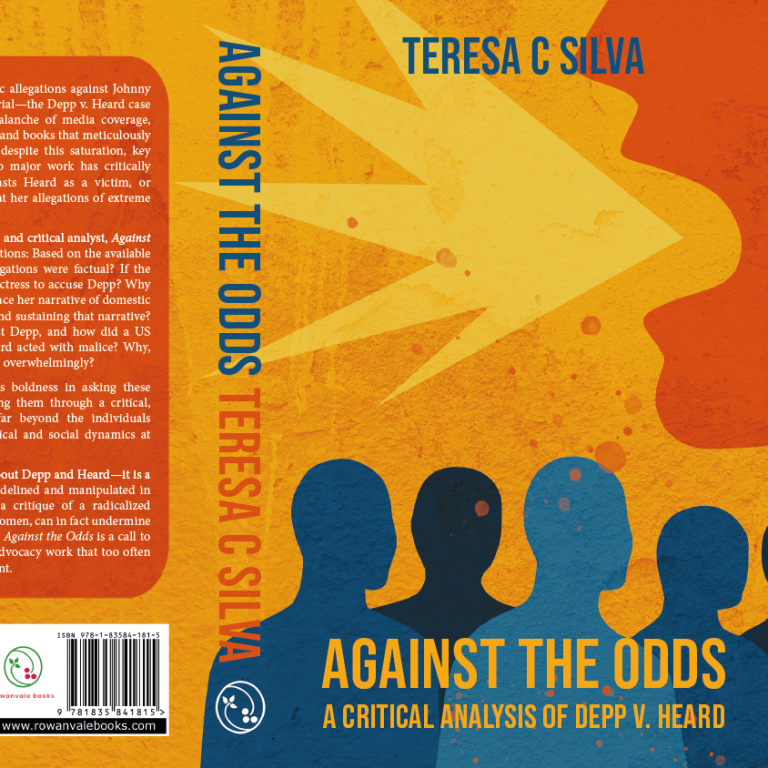
Against the Odds is an evidence-based analysis of the Depp v. Heard case that moves beyond celebrity spectacle to examine how allegations of intimate partner violence are constructed, believed, challenged, and adjudicated within contemporary legal, media, and cultural contexts. Grounded in psychology, victimology, and forensic analysis, the book asks a fundamental question: how can two legal systems, presented with similar bodies of evidence, reach radically different conclusions about the same allegations?
The case began in May 2016, when actress Amber Heard accused her husband, actor Johnny Depp, of repeated and severe domestic abuse and sought a restraining order. The allegations rapidly spread across legacy media and social platforms, generating intense public polarization. While Depp consistently denied the accusations, details of the relationship remained largely inaccessible until the initiation of libel proceedings in the United Kingdom in 2018 and later in the United States.
Divergent legal outcomes and the problem of credibility
In the UK proceedings, Depp sued a newspaper and one of its executive editors over an article that labeled him a “wife-beater.” In a 2020 judgment, the High Court concluded—on the civil standard of the balance of probabilities—that Depp had committed violence against Heard in the majority of the incidents she reported. The ruling legitimized the media’s use of the label and reinforced a narrative that had already gained traction in public discourse.
Two years later, a jury in Virginia reached the opposite conclusion. In the US defamation trial, Depp sued Heard directly over an opinion article in which she described herself as a public figure representing domestic abuse. After weeks of testimony and the live broadcast of the proceedings, the jury found that Heard had lied with malice and that Depp had not committed the violence she alleged. The stark contrast between the UK and US outcomes raises pressing questions about credibility assessment, evidence evaluation, narrative framing, and the influence of media environments on legal reasoning.
A forensic, hypothesis-driven approach
The first part of Against the Odds adopts a micro-level, forensic perspective, placing the alleged victim at the center of the investigation. The analysis proceeds as a forensic evaluator might approach a case: by formulating hypotheses and testing them against available evidence. Drawing on court documents, witness statements, depositions, photographs, audio recordings, medical records, and expert reports, the book examines the internal consistency of Heard’s allegations, her reported injuries, and her behavior across different contexts and over time.
Particular attention is paid to discrepancies between early depositions and later courtroom testimony, as well as to interactions with individuals in her close environment. Based on this material, the book proposes and evaluates alternative hypotheses regarding the nature of the allegations, including the possibility that they were false. Rather than relying on moral judgments or partisan positions, the analysis is anchored in established psychological and forensic principles concerning deception, credibility, and victim presentation. The conclusions are presented as hypotheses, not claims of absolute truth, reflecting scientific caution and the limits inherent in retrospective case analysis.
Media narratives, victimhood, and moral framing
The second part of the book expands the lens to a macro-level perspective. It examines how Heard’s narrative gained traction within a broader cultural context characterized by heightened sensitivity to victimhood, power asymmetries, and gendered assumptions about violence. The analysis shows how media outlets, advocacy networks, and opinion leaders often privileged narrative coherence over evidentiary scrutiny, marginalizing dissenting interpretations and equating skepticism with hostility toward victims of abuse.
A substantial portion of the book is devoted to the role of legacy media in shaping public understanding of the case. Through the examination of articles published across multiple countries, recurring patterns of language, framing, and moral positioning are identified. These patterns contributed to Depp’s professional and social ostracism long before any judicial determination of facts had been made.
The “Depp Effect” and its broader implications
Alongside the media analysis, the book explores the rise of social media counter-discourses and the growing distrust of traditional journalistic authority. This dynamic culminates in what the author terms the “Depp Effect”: a complex interaction between legal outcomes, media narratives, public backlash, and shifting attitudes toward victimhood claims.
While rooted in a specific case, the Depp Effect reflects broader tensions in contemporary societies about justice, belief, gender, and power. It captures the collision between absolutist moral narratives and public demands for transparency, evidence, and accountability.
Beyond the case
Throughout the book, the author draws on scientific literature, professional experience in forensic and clinical contexts, and conversations with survivors of domestic violence. These perspectives reinforce a central argument: intimate partner violence is a profoundly serious issue that requires careful, evidence-based engagement, not ideological simplification. Questioning specific allegations does not undermine victims as a group; rather, justice depends on the ability to distinguish between cases, contexts, and individuals.
Against the Odds is written for readers interested in psychology, law, media studies, and contemporary social debates. It does not ask readers to take sides, but to think critically about how truth is constructed, how credibility is assessed, and how easily complex human relationships can be reduced to simplistic narratives.